
Good Quote. Gross Oversimplification.
What Robert Brault got right — and what some authorities conveniently leave out.

I love a good quote. A few years back, I heard this one:
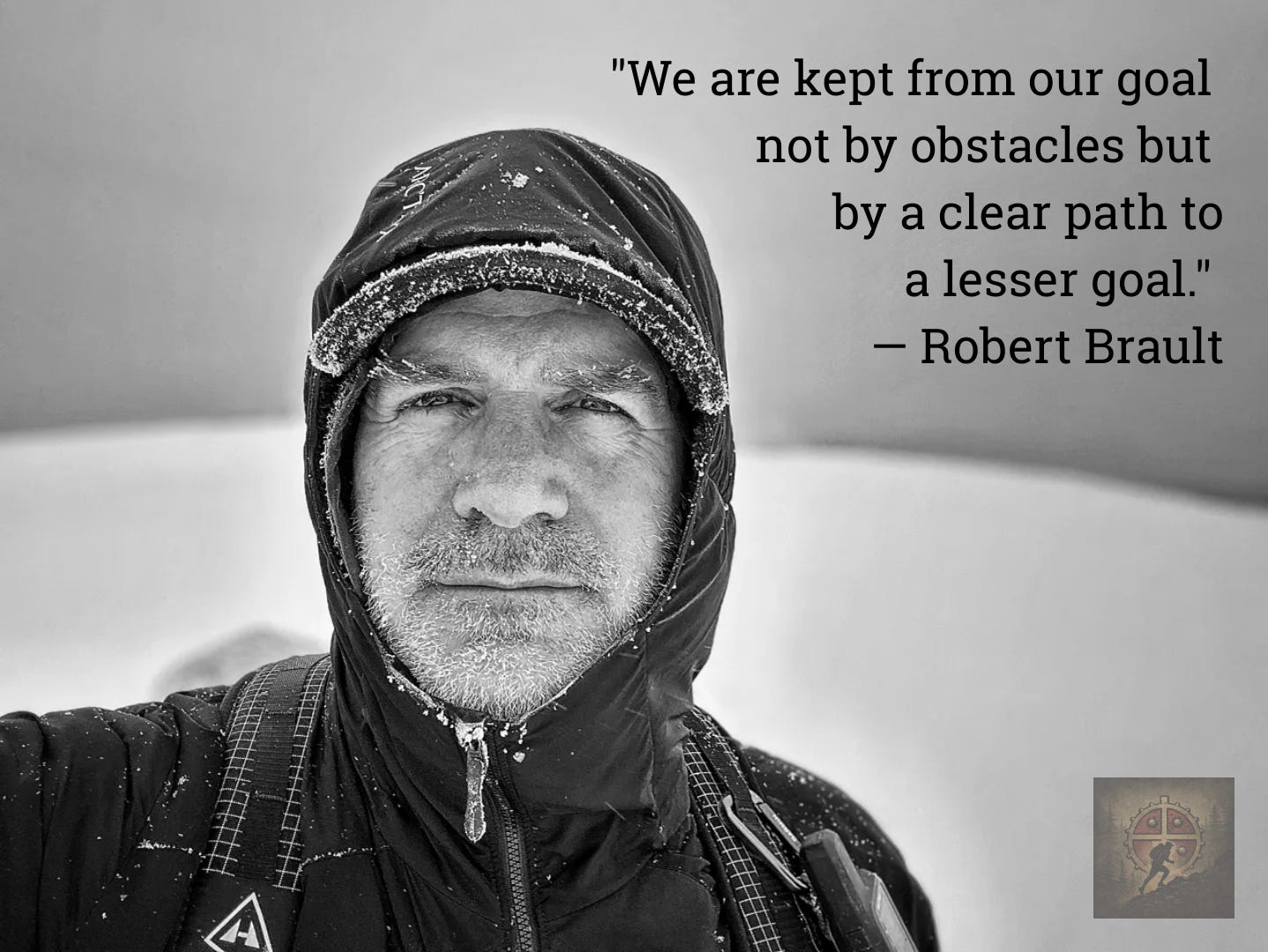
“We are kept from our goal not by obstacles but by a clear path to a lesser goal.”
— Robert Brault
It landed like a punch to the sternum.
[oof]
Is that me?
Am I choosing the clear path because it’s clear… not because it’s right?
Am I disciplined — or just cleverly distracted?
Am I ambitious — or safely busy?
For a split second, it felt like exposure. Like someone had reached into my internal monologue and underlined a weakness.
Have you ever had a single sentence do that to you?
“We are kept from our goal not by obstacles but by a clear path to a lesser goal.”
While I imagine Robert Brault had more to say about his statement, we’ll never know. From what I can see, his words didn’t come from a book, an essay, or even an interview. It’s a standalone quote. Period.
Hmmm...
While I love a good quote. What I don’t love is when someone borrows the thoughts of others and presents them as universal wisdom… worse, a diagnosis.
I cringe. Not a little. A lot.
On the surface, the quote is’t wrong. Pragmatically, it makes sense.
In its present form by itself, however, it’s grossly incomplete... and sharing incomplete, borrowed wisdom like an already-open bag of Skittles isn’t actually useful; it’s bordering on irresponsible.
That last part, “…but by a clear path to a lesser goal,” without context, and shared by those speaking from a position of status and abundance, it comes off as condescending and arrogant. Dismissing the behaviour of others as weakness, unfocused, lack of ambition is lazy coaching dressed up as wisdom.
First, some fun facts about our brains.
The brain isn’t wired for thriving — it’s wired for survival. If you’re fighting something right now — physically, financially, relationally, emotionally, professionally, etc — your nervous system doesn’t actually give two shits about your goals, and even less about your BHAG (big hair audacious goal). It cares about making it to tomorrow.
Here’s what’s actually happening when progress stalls: the brain values certainty over accuracy. Assumption is reflexive. It costs almost nothing. Accuracy — real examination of who you are, what you want, and why you keep choosing the familiar — that costs something. Time, energy, discomfort, and the willingness to be wrong about yourself.
Meaning, most people aren’t choosing a lesser goal. They’re choosing certainty and less pain. That’s not a character flaw or moral failing. That’s biology.
Another fun fact. The brain values familiarity.
Change requires you to leave the familiar behind. Not just your habits — your ideas, your identity, your interpretations of the world around you, belief systems, and the stories you’ve been telling yourself so long you’ve mistaken them for facts.
Our brains don’t like change; thus, our brains cling to all of it equally. And it will keep clinging until the discomfort of staying where you are becomes greater than the fear of moving away from it.
Change creates disorder. Disorder is the chaos between who and where you are vs who and where you’re growing to be. It’s not a detour. It’s the actual uncomfortable path forward.
Think of a storm sitting between where you are and where you’re going. Wind. Rain. White‑knuckle visibility. Unless the road is completely washed out, you don’t turn around and pretend the destination doesn’t matter. You slow down. You grip the wheel. You keep moving.
You don’t outthink a storm. You go through it.
Growth and goal achiement works the same way. It’s less “one clean breakthrough” and more steady pressure — one next step, then another, then another. Not dramatic. Not glamorous. Just consistent forward motion while everything in you wants certainty and familiarity... comfort and clarity.
The storm isn’t proof you chose the wrong goal. It’s proof you’re between orders.
Consistency beats intensity every time. Small, repeated effort builds a new familiar. And eventually, what once felt like risk starts to feel like your new normal. Welcome to the new order. The reorder.
The final point that people miss when they share this quote: it implies the lesser goal is somehow a failure of ambition, focus, and intention. Exercise some self-compassion and consider that sometimes it’s a failure of support, capacity, or timing. Sometimes the path forward requires you to stabilize before you can accelerate.
Life is hard sometimes. Sometimes it’s harder.
Wouldn’t it be convenient if every stalled goal was just a mindset problem? If every detour was proof of small thinking? If the only thing standing between you and greatness was courage?
That narrative sells. It sounds sharp and gets a lot of [clicks]. It flatters the people who’ve already made it through the storm.
But when someone speaks from a place of stability, wealth, or status and reduces other people’s lived reality to “you chose the lesser goal,” that’s not insight. It’s just rhetorical horseshit.
Humans are coplex and life is messy.
Real leadership, real coaching, real wisdom... it accounts for context. Capacity. Trauma. Timing. Support. Nervous system load. Season of life. Etc, etc, etc.
Before you diagnose someone’s ambition, let alone your own, get curious and ask whether they have the bandwidth to carry it.
Sometimes the bravest move isn’t acceleration. It’s stabilization.
And if you haven’t taken the time to understand the weight someone is carrying, restraint is wiser than rhetoric.
There - I said it.
I’m Vince Fowler. Follow me for more dogmatic contradictions.
#TheoryOfaRunningman